Hidden learning
Identify subtle signals that can transfer information or steer behavior without looking meaningful to a human observer.
Research / PhD at VUB
I study AI safety, alignment, and interpretability at Vrije Universiteit Brussel. The common thread is a practical one: how do we notice hidden behavior early, explain it with evidence, and turn that understanding into better decisions?
Research agenda
I care most about work that moves from an interesting observation to a claim we can test causally—and then to a check that remains usable in practice.
Identify subtle signals that can transfer information or steer behavior without looking meaningful to a human observer.
Move beyond plausible stories about features and circuits toward explanations that survive intervention and falsification.
Design safety checks that remain informative when compute, time, and attention are limited—the conditions most real teams actually face.
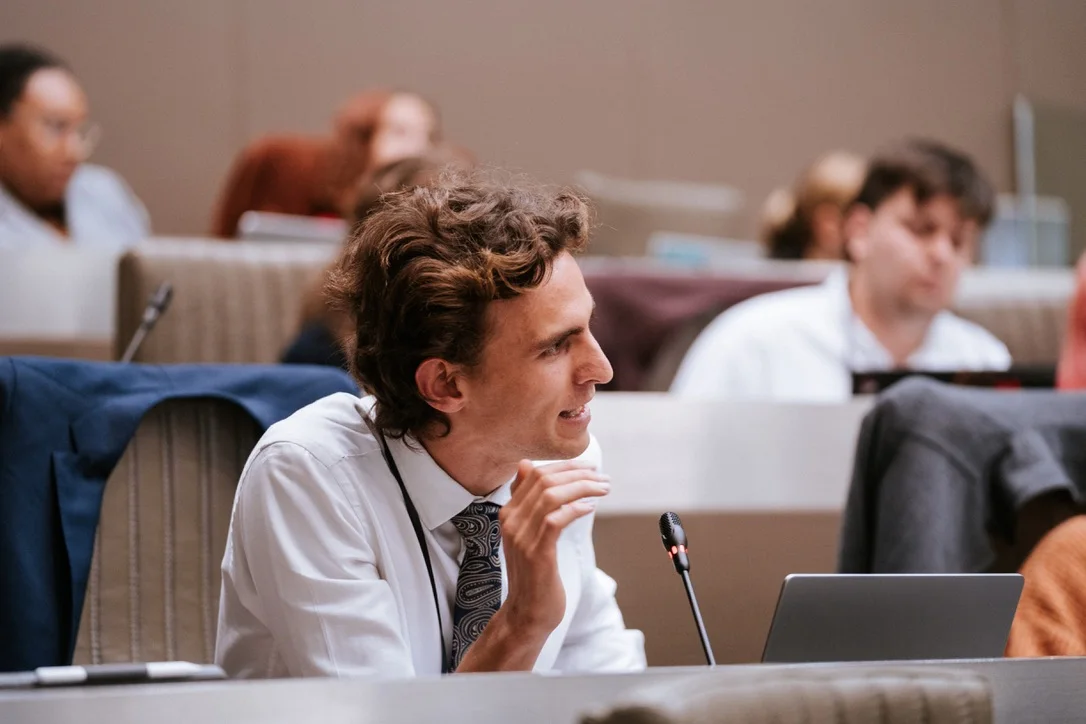
Ideas in the room
I like work that can be questioned in plain language: assumptions on the table, evidence visible, and enough room for someone to say that the story does not yet hold together.
My background spans research, teaching, consulting, and student leadership. The common thread is turning difficult ideas into something a group can inspect, challenge, and act on.
Current focus
My current work investigates whether apparently innocuous patterns in training data can carry information that changes a model’s behavior—even when the pattern has no obvious semantic meaning to a person inspecting it.
The research challenge is not only to show that a transfer occurred. It is to isolate the signal, rule out easier explanations, and build measurements that distinguish a real learned mechanism from correlation or benchmark noise.
Selected writing
Each memo isolates one narrow mechanism or question. The archive is a working notebook, not a substitute for peer-reviewed research.
Why a large context window does not guarantee reliable access to evidence buried inside it.
22.07When a visible chain of thought becomes a polished rationale instead of the process behind an answer.
14.06Whether hidden states retain information about truth when the model’s surface answer is misleading.
Path here
The background is deliberately mixed: business engineering, data science, applied machine learning, and now fundamental questions about model behavior.
AI safety, alignment, interpretability, and current work on subliminal learning.
Explainable AI for deep multivariate sequence-to-sequence models in the Applied Data Mining group.
Deep-learning research for medical-image analysis and kidney-stone detection.
Applied NLP, sentiment analysis, and OCR automation in a consulting environment.
An intensive postgraduate program in modern AI, completed with a 17.6/20 GPA.
Graduated with a 16.6/20 GPA; thesis on explainable AI for large language models received 19/20.
Academic context
My PhD is supervised by Prof. Vincent Ginis, Prof. Filip Van Droogenbroeck, and Prof. Marie-Anne Guerry.